

Martin Goodman
[The writer is a novelist and ardent wildlife supporter known for his ecological advocacy. He is based in the UK. martingoodman.com]
Follow the Mediterranean coastline south around Spain and eventually you reach Marbella. Go along the walkway an extra mile beyond the city and you find a wooden pier reaching out into the sea. It belongs to the Marbella Club. Walk along it, look out, and you may well see dolphins arching their bodies out of the water. Turn around and take the steps uphill, past a swimming pool, and you are in the Marbella Club’s grounds.
This is a luxury resort, with holiday apartments sited through gardens first planted seventy years ago. Our own apartment overlooked a swimming pool near the top of the Club’s slope. Sit on the balcony in the morning, sip tea, turn on the Merlin birdsong identification app on your phone, and you can catch the location of each species as it wakes up: the greenfinch topping the tree to the left, the scratchy song of Sardinian warblers in the shrubs below, the thin call of the firecrest from a distant pine. Twenty-seven species in all, including the peregrine falcon that shrieks after dark before settling in its roost.
La Concha Conversations
This isn’t a place we would usually afford. We’re guests as the Club holds the second of La Concha Conversations, in which people active in protection and conservation of the natural world meet to share experiences. I’ve come to tell the group about the Bishnoi as featured in my book My Head for a Tree. The talks and panel discussions take place on the neighbouring land.
From Desert to Garden
This new acreage has doubled the Marbella Club’s footprint. Once the grounds of the neighbouring estate, the land had turned to desert and scrub. Call this ‘building land’ and new apartment blocks would soon fill with guests and bring in money. This, they haven’t done.
Instead, they planted a garden. My first visit was in 2024. By November 2025, plantings had expanded and grown in, and a clear logic was emerging.
The Prince Gardener’s Vision
I’ll let Prince Louis Albert de Broglie take up the explanation. Known as the ‘Prince Gardener’, renowned for the National Tomato Conservatory back in his French chateau, he was brought in to imprint the new garden with his sustainable vision. A group followed as he led us, barefoot, into the project.: ‘Barefoot is the way to connect with the earth,’ he tells us.
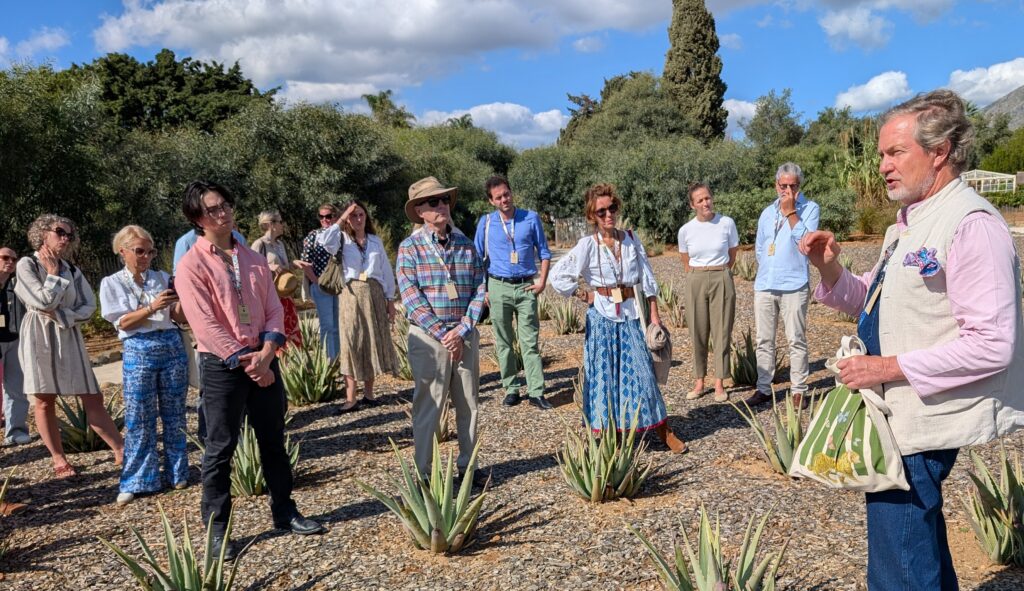
His lessons begin among a spiral of spiky aloe vera plants. ‘It is important to protect rather than build,’ he begins. ‘That’s part of stakeholder responsibility. Two years ago this was desert land. Now it is not only a beautiful garden – but a meaningful ecosystem.’
After a couple of days I begin to wonder about what isn’t here: namely, weeds. Where are the wildflowers dropped as seeds by passing birds? The answer is that the weeds have been cleared away by the team of nine that now manages this land. This is a garden, not a rewilding project. Using the language of environmental science the Prince points out the logic: ‘Positive externalities of the garden can generate revenues.’
As we walk the land, I recognize that we guests that are inhabiting it for a few days, buzzing with our eco conversations, are experiencing this ‘positive externality’. Revenues come from the paying guests next door, and an interflow between this garden and the guests enhances the Club’s attraction. As the Club’s owner Jennica Arazi, tells us, ‘People are at the heart of what we do. If you can touch somebody, hopefully it will stay with them for the rest of their life.’
Permaculture Principles
‘The motto of permaculture?’ the Prince poses, as we pass a high stand of acacia, an invasive species in these parts. ‘The problem is the solution.’ In this instance, rather than remove the acacia, by shaping and controlling its growth they had turned it into a maze. Children now come here and have fun engaging with the maze.
Alejandro Orioli takes up the tale. Elsewhere in Marbella he is Director of the Arboretum Project, a charity restoring scrubland into a public forest using trees, shrubs, grasses and vines that are local to the region. That forest is being developed using permaculture principles, and that same logic extends to his oversight of this new project.
Ask Alejandro about the techniques he uses in his gardening and you’ll get short shrift. ‘It’s not about the technique,’ he says. ‘It’s not what we do but why we do it. The goal is that every time we use the soil life springs again.
‘Before doing something, start with a filter. Is it going to be favourable or unfavourable to life? Biodiversity is fundamental to life – the more we enhance it, the more safety, health and resilience we have. At Marbella, at the door of the desert, each year it rains less. We get less than 400ml a year. But instead of vertical rain we have horizontal rain – the morning breeze moisture to the land from over the sea. We have plants that put this water into the soil.’
From Soil to Plate
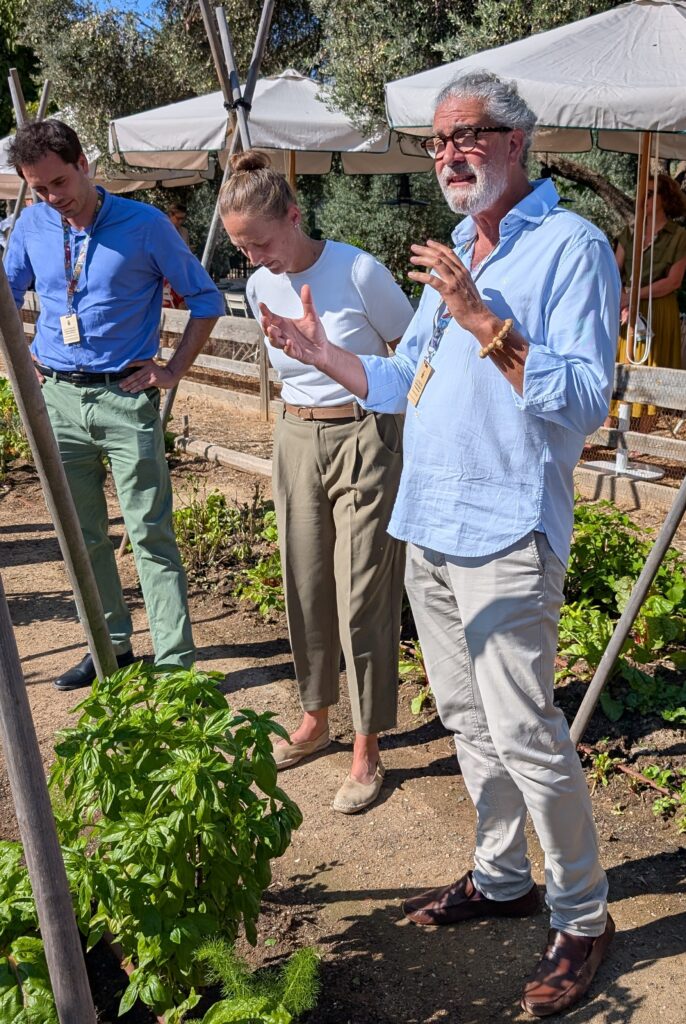
Hotel guests chew through 190kgs a week of tomatoes in summer, and that summer’s crop had included 240 different varieties. A giant among the local ones is the Beefheart tomato, a single one weighing in at 1.6kg – chefs turn them into Beefheart entrecote steaks.
The hotel is big on ‘upcycling’. Fruits left untouched in guests’ welcome baskets are turned into jams or flavour the hotel’s home-brewed kombucha. They ferment their own vinegar – a cherry vinegar gave a red tinge and non-astringent taste to the pickled vegetables I tasted. Herbs from the garden flavour waters and decorate the hotel. The hotel has its own upcycling laboratory, with people working to identify novel plants and plant-parts that could be used in the kitchen. A new experiment is with cauliflower leaves – through a fermentation process, similar to that used to make kimchi, they soften the fibrous tissue to make the leaves edible.
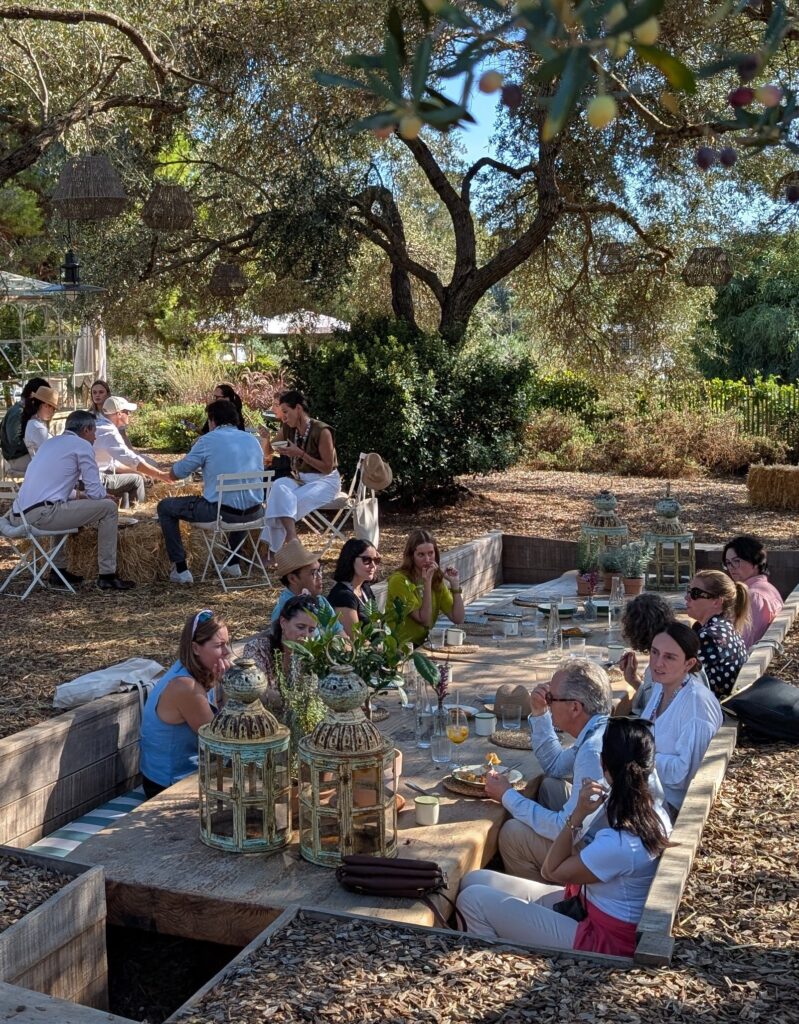
Our tour of the garden concludes with lunch served on tables set in the shade of trees. Guests are brought out here to share meals inside the garden: it ‘connects soil to the plate,’ the Prince declares, and we all tuck in.
A Garden for All
That afternoon my own panel takes place under what has been designated ‘The Story Tree’. While this garden is part of a luxury resort, whose aim is to brings its guests a sense of ‘wholeness’, it is not exclusive. Locals are welcomed to come and find their own connections, through the garden, with this planet which we all share. Children are especially welcome. They climb on top of a ring of straw bales, turn to the storytellers under the tree, and listen to tales of the miracles of life.
